Quick answer
start with an easy food search, a hand target or a familiar toy game. Keep the challenge solvable and stop if your dog becomes frustrated. The point is an enjoyable activity, not proving intelligence.
Set the game up safely
Choose a quiet area with secure footing. Count food rewards as part of your dog’s normal intake. Supervise every new activity, and avoid loose small objects, string, staples or materials your dog might swallow. Separate dogs for food games if competition or guarding is possible.
Dogs Trust lists enrichment as one way to add opportunities for natural behavior and learning. It also emphasizes rest. Do not use games to keep an already tired dog busy all evening.
1. The easy food search
While your dog watches, place a few pieces of their normal food in clear view on a clean floor. Say a simple phrase such as “find it” and let them search. On later turns, spread pieces a little farther apart. There is no need to hide everything immediately.
If searching becomes frantic or your dog guards food, stop and choose a different activity with professional guidance where needed.
2. A familiar toy, slightly hidden
Place a favorite, suitably sized toy partly behind a cushion while your dog watches. Invite them to find it. Keep the first hides obvious and accessible without climbing or pulling furniture.
If your dog does not enjoy retrieving, finding the toy can be the whole game. Do not insist they bring it back to your hand.
3. The hand-target game
Offer a palm beside your dog’s nose and reward a comfortable touch. Move the hand only a small distance between repetitions. Skip face-level hand games if your dog is wary of hands. Our focus guide explains the first steps.
4. A supervised towel scatter
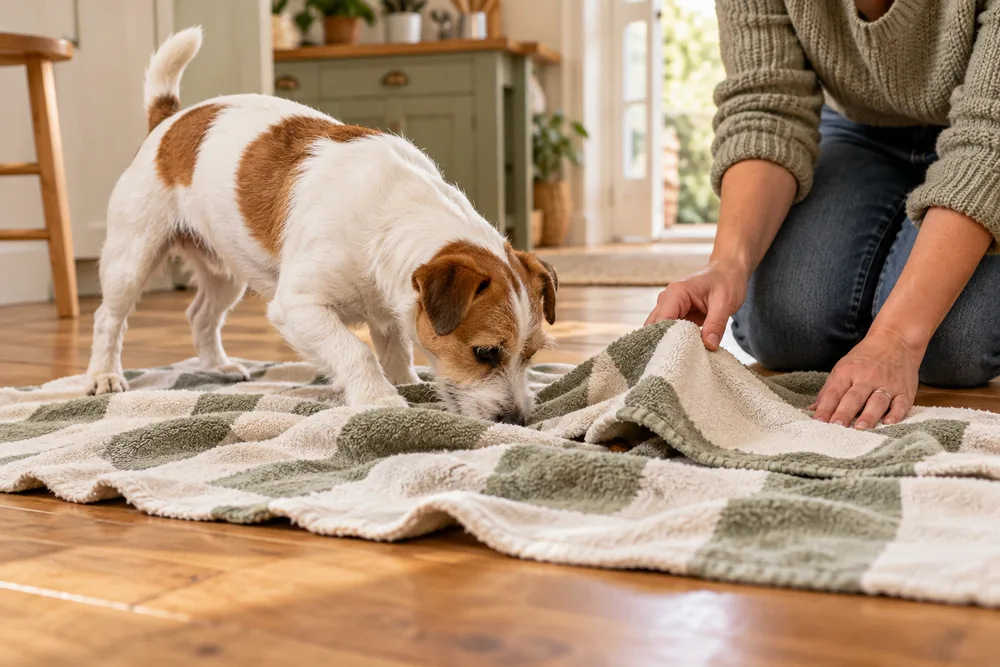
For a dog who does not eat fabric, place a few food pieces on a flat towel. Later, add one loose fold. Stay beside the dog and remove the towel if they chew or swallow it. Choose a bare-floor search instead if materials are a concern.
Hard knots and tightly rolled towels are not a necessary upgrade. Easy access can still be worthwhile.
5. Find your person
In a secure home, have a familiar adult stand just behind an open doorway and call once. Reward the dog for coming over. Begin with the person nearly visible and keep the distance small.
This is a short social game, not a treatment for separation distress. Do not hide from a dog who becomes upset when they cannot find you.
6. Two-step toy tidy practice
If your dog already enjoys picking up and releasing a toy, place a low, stable basket near where they usually drop it. Reward a release into the basket. Make the target easy and stop before frustration.
If they do not have these foundations, practise the simpler toy game first. Avoid taking objects forcibly or continuing if guarding appears.
How to choose tomorrow’s game
Note which activity your dog approached willingly and could leave comfortably afterward. Repeat an easy favorite before increasing difficulty. Novelty is optional; enjoyment is the goal.
Common questions
How many minutes are enough?
There is no universal prescription. Start briefly, observe interest and comfort, and leave space for rest.
Will games stop barking or chewing?
They can be one part of a fuller routine. They do not identify or treat every cause of unwanted behavior.
Further reading
Dogs Trust: enrichment activities. The six setups above are original editorial examples, not copied course lessons.