Quick answer
start in a quiet place and reward brief moments of attention. Practise a check-in, a name response or a hand target separately. Attention should help your dog navigate the world, not prevent normal sniffing and exploration.
Set up for a small success
Choose a safe space with little going on. Use small rewards your dog can comfortably eat and keep the session short. If your dog walks away, let them pause. A lesson that depends on repeatedly pulling them back is too difficult or poorly timed.
Decide which response counts before beginning. “Be good” is vague. “Turn toward me when I say your name” gives both of you something clear to practise.
Exercise 1: the voluntary check-in
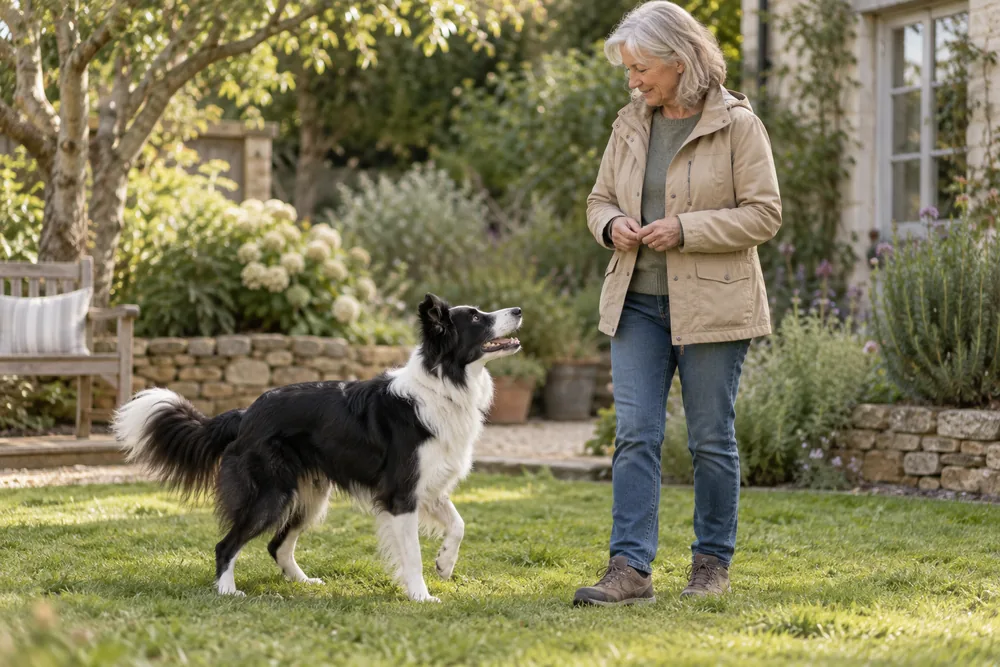
Stand quietly near your dog. The moment they turn toward you, say “yes” and reward. Let them look away again. Repeat a few times without saying their name or holding food in front of your face.
The useful part is the choice to reconnect. You are not asking for a long stare. On a quiet walk, a spontaneous glance can earn a reward and permission to continue sniffing.
Exercise 2: make the name useful
At home, say your dog’s name once in a friendly voice. When they orient toward you, mark and reward. If they do not respond, try a quieter setting or a shorter distance at the next attempt.
Avoid using the name repeatedly to interrupt everything your dog enjoys. Keep early repetitions easy. Once it is reliable indoors, practise near an open doorway before attempting a busy street.
Exercise 3: an optional hand target
Present an open palm a little to the side of your dog’s nose. If they comfortably investigate or touch it, mark and reward from your other hand. Remove the target hand between repetitions. After several easy successes, add a word such as “touch” before presenting it.
Do not push the hand into the dog’s face. Skip this exercise if hands near the face cause worry, snapping or avoidance; seek suitable support instead. A target is a practical movement cue, not permission to move a dog into a frightening situation.
Build a distraction ladder
Write three places in increasing order of difficulty: quiet room, quiet garden, distant edge of a quiet park. Spend time where success is easy. Increase only one challenge at a time.
If your dog stops responding, move farther from activity or leave. The answer is not necessarily a tastier treat held closer to their nose. A dog can be too overwhelmed to learn comfortably.
Common mistakes
Training only when you urgently need attention makes every repetition hard. Practise during ordinary, low-pressure moments. Also avoid rewarding only sustained staring; the useful skill is reconnecting briefly, then returning to normal life.
Common questions
Does focus mean eye contact?
No. Turning their head or body toward you may be enough. Choose a comfortable response and keep your expectation clear.
Can I use toys?
If your dog enjoys them and can stay comfortable, yes. Choose rewards that fit the setting and the skill.
Further reading
Dogs Trust: reward-based training. The exercises and progression ladder above are editorial practice examples.