Quick answer
build a flexible rhythm around waking, toileting, meals, gentle activity and rest. Frequent opportunities to succeed are more useful than expecting a new puppy to understand household rules immediately.
Prepare a small, manageable world
Choose a safe resting area, block access to hazards and keep cleaning supplies ready for accidents. Make sure every adult knows the same basic plan: where the puppy toilets, where they sleep and what to do when they need a break.
Do not introduce the whole house, every visitor and every training exercise at once. A new home already contains a great deal to investigate.
Use events rather than a rigid clock
Offer a toilet opportunity after waking, eating or playing, and whenever the puppy shows signs they may need one. Go with them and reward successful toileting in the right place promptly. Expect individual variation; no timetable guarantees that accidents will stop.
If an accident happens, clean it without scolding and consider how to offer the next opportunity earlier. Punishment after the event does not provide a clear, useful lesson about where to go.
A simple repeating cycle
| Moment | Your next step |
|---|---|
| Puppy wakes | Offer a toilet opportunity |
| Comfortable and alert | A little gentle play, exploration or one easy lesson |
| After food or activity | Another suitable toilet opportunity |
| Interest fades or behavior gets frantic | Reduce demands and offer a calm resting space |
| Household becomes busy | Use safe separation and protect the puppy from overload |
This is a flexible example. Follow veterinary advice on feeding, health and safe outdoor exposure. A puppy with unusual urination, diarrhea, pain or marked lethargy needs a veterinarian rather than a tighter training schedule.
Introduce a crate only as a comfortable option
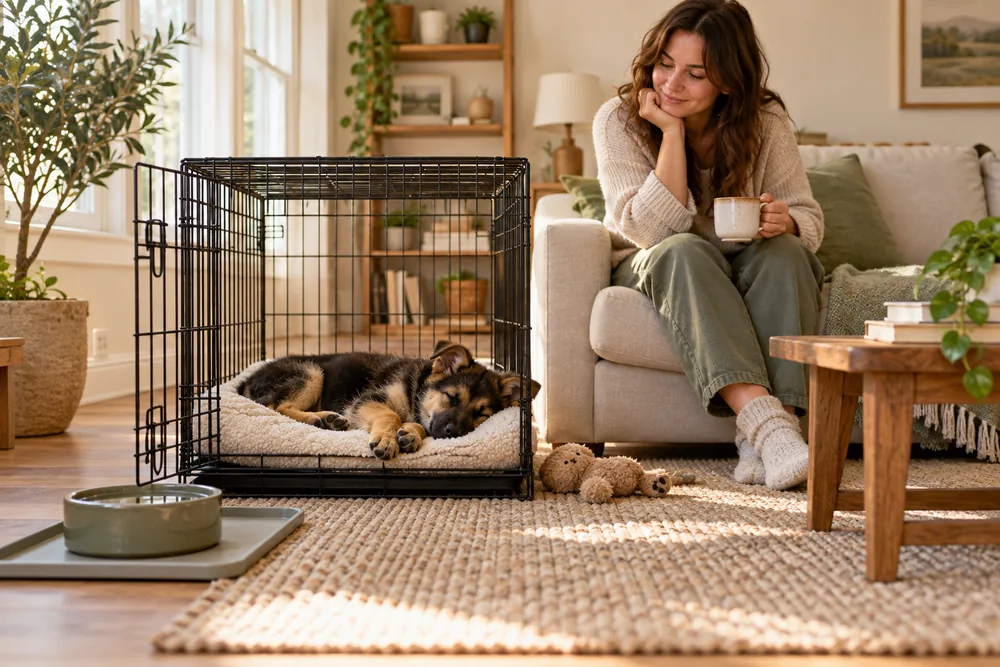
If you plan to use a crate, begin with the door open and let the puppy explore voluntarily. Build comfort in very small steps. The crate is not a punishment or a way to leave a distressed puppy to cry until they give up.
If confinement causes panic, stop and seek qualified advice. A safe pen or another managed resting arrangement may be a better immediate choice. Meeting toilet and social needs still matters.
Keep new experiences manageable
Social learning is not about forcing greetings. Let the puppy observe suitable experiences from a distance where they remain comfortable. Pair easy exposures with pleasant outcomes and allow retreat. Ask your veterinarian how to balance safe social exposure with local infectious disease risks.
Common questions
How much training belongs in the first week?
A few comfortable repetitions woven into ordinary life can be enough for a lesson. Protect sleep and avoid turning every interaction into a task.
What if different family members use different rules?
Write a short shared note: toilet place, reward word and how to pause play. Agreement makes the routine easier to understand.